
10 Jul 2026
Why Dual Key Living Appeals to Families Who Want Privacy and Connection
Key Takeaways
- A multi-generational home in Klang works when it resolves the central tension of family living: everyone wants to be close enough to help each other, and private enough to maintain their own routines.
- A 2026 study by researchers from Universiti Teknologi MARA, drawing on 398 respondents across four Malaysian generations, identified personal privacy and communal areas as two of the four core physical features Malaysian families require in multi-generational housing, confirming that both needs must be met simultaneously rather than traded off against each other.
- A Dual-Key configuration places two fully self-contained living environments within one strata title, giving each generation their own entrance, bathroom, and kitchen while keeping them under the same roof.
- For families in the Bandar Botanic corridor, a dual-key condo in Klang combines that layout advantage with freehold tenure and LRT3 transit access 200 metres from Ambang Residensi, making the arrangement practical for daily life across all household members.
- The Dual-Key format also adapts across time. When a parent is no longer in residence, the secondary unit becomes a rental space, a home office, or a private room for a returning adult child, without any renovation.
Introduction
 Malaysian families who move in together across generations rarely do so because they want to share every moment of every day. They move in together because someone genuinely needs to be nearby.
A parent’s health is changing and support is needed nearby. The grandchildren need looking after during school hours. The commute from a separate rental is expensive and exhausting. The reasons are practical, but the emotional arithmetic is more complicated: proximity is wanted, but so is a door that closes.
That tension between wanting family close and wanting your own life is the defining challenge of multi-generational home life in Klang and across Malaysia. The Dual-Key format doesn’t try to dissolve that tension. It resolves it through design.
Malaysian families who move in together across generations rarely do so because they want to share every moment of every day. They move in together because someone genuinely needs to be nearby.
A parent’s health is changing and support is needed nearby. The grandchildren need looking after during school hours. The commute from a separate rental is expensive and exhausting. The reasons are practical, but the emotional arithmetic is more complicated: proximity is wanted, but so is a door that closes.
That tension between wanting family close and wanting your own life is the defining challenge of multi-generational home life in Klang and across Malaysia. The Dual-Key format doesn’t try to dissolve that tension. It resolves it through design.
What Is a Multi-Generational Home in Klang?
A multi-generational home in Klang is a residential unit where two or more generations of a family live in the same building or on the same strata title, typically including parents, adult children, and sometimes grandchildren. A 2026 peer-reviewed study by researchers from Universiti Teknologi MARA, based on 398 respondents across four generations in Shah Alam, identified personal privacy and communal areas as two of the four core physical features that Malaysian families across all generations require in multi-generational housing environments. The study found that these two features are both essential and, by design, in tension with each other: families need spaces where generations can come together, and spaces where each generation can be entirely separate. A multi-generational home in Klang that achieves both is not simply a larger unit. It is a unit designed with structural separation built in from the start.Why Privacy and Connection Are Both Non-Negotiable
It is tempting to think of privacy and connection as a dial: more of one means less of the other. Families who move in together often discover that treating them this way is where the arrangement begins to fail. When a parent shares a kitchen with an adult child’s household, small things accumulate. The grandparent who rises at 5:30 am to make tea moves through the same space where the baby was just settled. The adult couple who want to discuss something privately can hear the television from the next room. The parent who wants to cook a long-simmering dish on a Sunday afternoon occupies the kitchen during the time the family planned lunch. The toddler who naps at 2 pm requires quiet from everyone during exactly the hours the household would otherwise be most active. None of these are catastrophic incidents. Each one is manageable once, or even ten times. The difficulty is that they are cumulative and invisible. Over months, the daily friction of shared spaces changes the quality of the family relationship in ways that neither party can easily name or address. People don’t leave multi-generational arrangements because of a single event. They leave because the small daily adjustments stopped feeling like care and started feeling like constraint. The closeness that was the reason for moving in together becomes the source of the strain. This is why personal privacy is listed as a non-negotiable alongside communal areas in the UiTM research, not as a luxury or an upgrade, but as a requirement for a functional family privacy condo arrangement. Families don’t want to choose between being together and having their own space. The housing design has to provide both.What Dual Key Design Does Differently
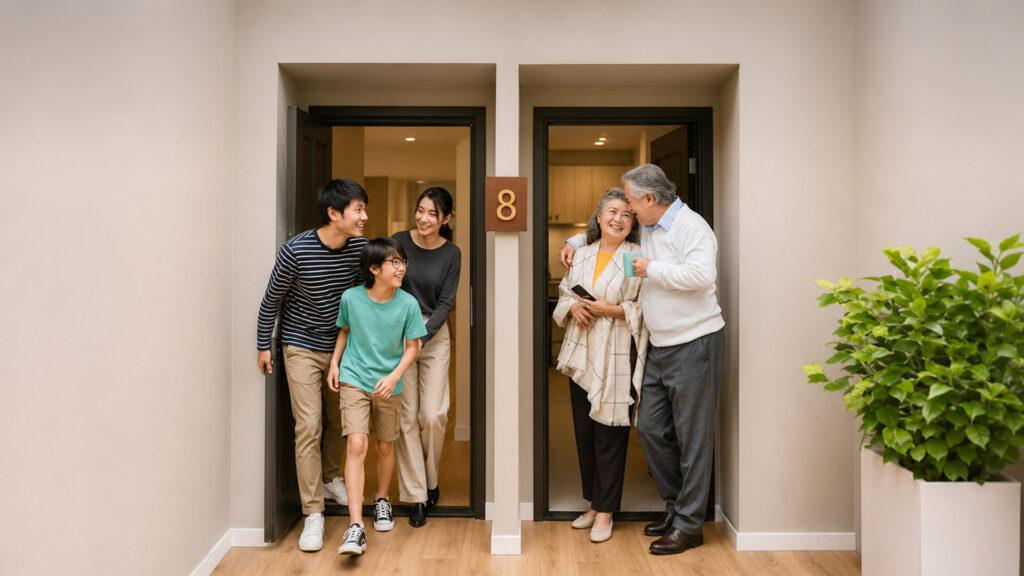
 A Dual-Key configuration gives each living component its own front door. That sentence sounds simple. Its practical consequences are significant.
When a parent in the secondary unit starts their morning, their routine doesn’t pass through the adult children’s living space. They use their own bathroom, make tea in their own kitchen, and leave by their own entrance. The adult household in the primary unit wakes on their own schedule. The children’s morning routine doesn’t involve navigating around a grandparent’s preferences. Neither party has to time their movements around the other.
The same logic applies in the evening. The parent can go to bed at 9 pm with the lights off and the television silent in their component. The adult household can watch a film at 10:30 pm without adjusting the volume. A late-arriving family member buzzes into the primary entrance without passing through the secondary unit at all.
This is what a flexible home layout in a Dual-Key achieves: it separates the daily routines without separating the relationship. The family can share a Saturday morning breakfast in the primary unit’s dining room because they choose to. They go back to their own spaces because the design permits it. For a family thinking about a family privacy condo arrangement in Klang, this distinction is the one that determines whether multi-generational living feels like a gift or an obligation.
A Dual-Key configuration gives each living component its own front door. That sentence sounds simple. Its practical consequences are significant.
When a parent in the secondary unit starts their morning, their routine doesn’t pass through the adult children’s living space. They use their own bathroom, make tea in their own kitchen, and leave by their own entrance. The adult household in the primary unit wakes on their own schedule. The children’s morning routine doesn’t involve navigating around a grandparent’s preferences. Neither party has to time their movements around the other.
The same logic applies in the evening. The parent can go to bed at 9 pm with the lights off and the television silent in their component. The adult household can watch a film at 10:30 pm without adjusting the volume. A late-arriving family member buzzes into the primary entrance without passing through the secondary unit at all.
This is what a flexible home layout in a Dual-Key achieves: it separates the daily routines without separating the relationship. The family can share a Saturday morning breakfast in the primary unit’s dining room because they choose to. They go back to their own spaces because the design permits it. For a family thinking about a family privacy condo arrangement in Klang, this distinction is the one that determines whether multi-generational living feels like a gift or an obligation.
Privacy in a family home is not about wanting to be away from each other. It is about having the structural option not to be together, so that choosing to be together is something the household does freely rather than because the layout leaves no alternative.
The Connection Stays Because the Privacy Is Protected
The counterintuitive finding in multi-generational housing research is that the families who live together most successfully are not the ones who share the most space. They are the ones whose private space is most clearly protected. When a parent knows they can close their own front door and be entirely in their own environment, they stop accumulating the small frustrations that come with feeling like a guest in someone else’s daily routine. When adult children know the secondary unit is genuinely separate, they stop managing around the parent’s schedule throughout the day. Both parties relax. The relationship between the generations improves because the pressure on it decreases. For families evaluating a family privacy condo arrangement, this is the insight that matters most: the arrangement that feels most connected is usually the one with the most clearly protected private space. A Dual-Key unit achieves that by design rather than by household rule. This is why a Dual-Key configuration produces a different quality of family relationship than a spare bedroom arrangement. A spare bedroom offers privacy only in the bedroom itself. The bathroom, kitchen, living room, and entrance are all shared. The parent is always in the household’s common circulation. The adult household always knows when the parent is awake, when they’ve eaten, and when they’ve gone out. That level of involuntary knowledge about each other’s routines is comfortable for some families and suffocating for others. A dual-key condo in Klang removes that involuntary knowledge as a structural feature of the arrangement. Each party finds out what the other is doing when they choose to find out, not because the shared floor plan makes it unavoidable.Why Klang Specifically Supports This Arrangement
A multi-generational home in Klang in the Bandar Botanic corridor works for this kind of family arrangement for reasons beyond the Dual-Key design itself. The corridor’s commercial layer, with AEON Bukit Tinggi 2.2km away, Manipal Hospital Klang within the area, and a full pharmacy and clinic strip in the surrounding precincts, means that an older family member has practical daily independence. They can reach a doctor’s appointment, pick up medication, or get lunch without requiring the adult household to drive them. That independence sustains the dignity of the arrangement in a way that a location without accessible amenities cannot. The LRT3 Bandar Bukit Tinggi station, 200 metres from Ambang Residensi, adds a transit option for older residents who have stopped driving. A grandparent who can reach Klang town or Petaling Jaya by rail without asking anyone for a lift has a quality of mobility that changes the texture of daily life in the multi-generational arrangement. The flexible home layout of a Dual-Key unit addresses the physical design of the living space. The LRT3 connection addresses the independence of movement that makes that design genuinely liveable in the long term. And the freehold tenure of the development means that this arrangement can be sustained across the household’s full planning horizon. There is no lease countdown reducing the unit’s value as the family continues to live in it.Is a Dual Key Multi-Generational Home in Klang Right for Your Family?
 A multi-generational home in Klang with a Dual-Key configuration works best when families seek closeness combined with structural separation. Dual-Key units give each generation a complete living environment under one freehold title and management fee. For Malaysian families balancing aging parents and busy households, this design resolves financial and relational needs.
