
28 Sep 2026
Why Serviced Apartments Are Getting More Attention From Modern Buyers
Key Takeaway
- A serviced apartment in Malaysia sits on commercial land title. That changes the electricity tariff, parcel rent, and assessment rates compared to a standard residential condominium.
- The Housing Development Act that protects residential condominium buyers does not automatically apply here. Buyer protections and vacancy terms are set by the Sale and Purchase Agreement (SPA) instead.
- Running costs are higher for serviced apartments than condominiums, but what you get in return depends entirely on the specific development.
- Ambang Residensi has a maintenance fee of 30 sen per square foot. The development is freehold, on commercial title, and will be completed in 2028.
- Location is the biggest factor in whether a serviced apartment holds its value over time.
Introduction
 More buyers are looking at serviced apartments. Younger households who want facilities without the cost of landed house ownership. Families exploring dual-key setups for parents or a rental stream. Investors who want flexibility built into a single title.
Each group has different motivations. The question they’re all asking is the same one: is this particular development actually worth it?
That’s a fair question, and it deserves a straight answer. Three things answer it: what a serviced apartment is, what it costs, and what makes one worth buying.
What Is a Serviced Apartment in Malaysia?
In Malaysia, the most important thing about a serviced apartment is what it sits on: commercial land title. Not the furnishings, not the lobby, not the gym. Commercial land title is what separates a serviced apartment from a standard residential condominium. It changes your electricity bill, your annual land taxes, and the legal framework that governs your purchase. Four things differ: land type, electricity rate, parcel rent, and how buyer rights are protected. Get clear on these before you commit. Ambang Residensi is a serviced apartment on a freehold commercial title in Bandar Botanic, Klang. Freehold means there is no lease clock ticking. Commercial title means the cost and legal structure differ from a standard residential condominium, in the ways covered below.The Running Costs: What You Actually Pay
The cost difference is real and shows up in a few places.Electricity
Serviced apartments pay a commercial electricity tariff rather than the domestic residential rate. Following TNB’s July 2025 tariff changes, the gap between commercial and domestic billing widened. A serviced apartment resident pays more per unit of electricity than in a residential condominium. Worth building into your monthly cost estimate before you sign.Annual Land Taxes
Two annual costs come in higher on commercial title: parcel rent and assessment tax. Parcel rent is based on unit size. Assessment tax is set by the local council. Both are recurring. Both are higher on commercial parcels than residential ones, and easy to miss when you’re focused on the purchase price.Maintenance Fee
At Ambang Residensi, the maintenance fee is 30 sen per square foot. A 700 sqft unit works out to RM210 a month. A 1,238 sqft unit comes to RM371. This covers shared facilities, security, and building management. Knowing this upfront means you can calculate the real monthly cost, not just the mortgage.Buyer Protection
Residential condominiums fall under the Housing Development Act (HDA), which sets statutory timelines for construction, handover, and defect rectification. Serviced apartments on commercial title don’t fall under the same framework automatically. Your protections, handover timeline, and defect liability period are written into your SPA instead. That doesn’t make a serviced apartment a risky purchase. It means your SPA does more of the heavy lifting. Have a conveyancing lawyer go through it properly before signing.Why Location Is the Real Deciding Factor
 Once you’re comfortable with the cost structure, the question becomes: does this location justify the premium?
In 2026, the Malaysian property market is selective. Developments in strong locations attract buyers and tenants. Those in corridors with a lot of competing supply and no strong anchor find it harder to sustain pricing. This is sharper for serviced apartments than for residential condominiums. Commercial title units are faster to build at scale and more exposed to oversupply where demand isn’t actually there.
What makes apartment living trends relevant here is not about interior design directions or amenity upgrades. It’s about where real demand comes from: transit, employment, an established township, and a retail base that actually works.
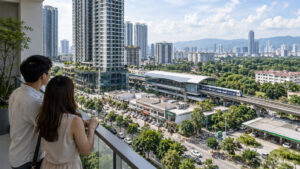
Bandar Botanic checks these. It’s a mature township in North Klang with an active retail corridor anchored by a major mall. Ambang Residensi sits directly opposite LRT3 Bandar Bukit Tinggi Station, connecting residents to the broader Klang Valley rail network. The infrastructure around the development isn’t still being built. It’s already there.
Freehold title adds a further dimension. A freehold serviced apartment doesn’t carry the lease renewal risk that comes with leasehold commercial titles. That has real implications for resale value and for the borrowing options available to future buyers.
