

18 Aug 2026
Defect Inspection New House: What Buyers Should Check Before Moving In
Key Takeaway
- A defect inspection of your new house must be conducted before renovation starts. Renovation voids defect liability coverage for affected areas.
- Under Malaysia’s Housing Development Act, the Defect Liability Period for residential strata properties is 24 months from the date of vacant possession.
- For serviced apartments on a commercial title, the DLP is not fixed by statute. It depends on what your SPA states.
- Every defect must be reported in writing. Verbal reports to the developer’s team do not create an enforceable record.
- A developer has 30 days to rectify a reported defect after receiving written notice under the HDA.
- The Tribunal for Homebuyer Claims (TTPR) handles cases up to RM50,000 per claim for HDA-protected properties.
Introduction
 Collecting your keys is one of the most important steps in the entire property purchase process. It is also the step most buyers rush through on excitement alone.
A defect inspection for your new house is not optional. It is how the developer’s warranty on your unit becomes enforceable. Without a formal inspection and a written submission, defects discovered months later are difficult to prove were present at handover.
This guide covers what to check, in what order and how to document and submit your findings. It also addresses serviced apartment buyers on a commercial title. Their defect rights sit outside the standard statutory framework.
Collecting your keys is one of the most important steps in the entire property purchase process. It is also the step most buyers rush through on excitement alone.
A defect inspection for your new house is not optional. It is how the developer’s warranty on your unit becomes enforceable. Without a formal inspection and a written submission, defects discovered months later are difficult to prove were present at handover.
This guide covers what to check, in what order and how to document and submit your findings. It also addresses serviced apartment buyers on a commercial title. Their defect rights sit outside the standard statutory framework.
What Is a Defect Liability Period and When Does It Start?
The Defect Liability Period (DLP) is the window during which a developer is responsible for repairing construction defects. All rectification is at no cost to you. For residential strata properties under the Housing Development (Control and Licensing) Act 1966, the DLP is 24 months. It begins on the date stated in your Vacant Possession notice. That is the date you collect your keys and take formal possession. The DLP clock starts on the VP date. It does not start on the date you move in or on the date you finish renovating. Mark the VP date on your calendar the day you collect your keys. For serviced apartments on a commercial land title, the DLP is not governed by the HDA’s 24-month statutory minimum. The period and the developer’s rectification obligations depend on the specific clauses in your SPA. Check your agreement and confirm the DLP start date and duration with your solicitor. Two documents arrive alongside your keys. The Certificate of Completion and Compliance (CCC) confirms the building is safe and suitable for occupation. Verify it references your specific block and unit number. The VP notice itself establishes your formal handover date. Keep both.What Should You Check Before Accepting Vacant Possession?
Before signing anything, confirm three things at the point of handover. First, verify the CCC is present and references your block and unit. Do not accept VP without this document. Second, request the developer’s defect notification form on the day. Third, do not begin renovation before your defect list has been submitted. Renovation can obscure original defects and void DLP coverage. A thorough defect inspection of a new house visit typically takes several hours. Bring a socket tester, a torch and a marble for floor evenness. Add masking tape and a marker to flag defects on-site and bring your camera for time-stamped photos. Document every defect you find with a photo before moving on.Room-by-Room: What to Inspect in a New Serviced Apartment
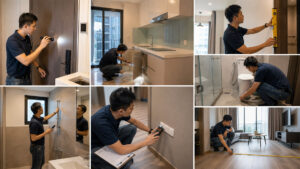 Work through the unit systematically. Start at the entry point and move room by room so nothing is skipped.
1. Front door and entryway
Check that the door closes flush, latches fully and does not scrape the frame. Test the lock mechanism. Look for gaps between the door frame and the wall.2. Walls and ceilings throughout
Look for cracks, hollow sections, paint bubbling and staining. Press suspect plaster areas gently with your palm. A hollow sound means the plaster is not bonded to the substrate. Check ceiling corners for hairline cracks and water staining.3. Floors
Walk the entire floor and listen for hollow tiles. Use a marble to check for uneven sections. Tile gaps should be consistent. Raised tile edges and irregular grout lines are reportable defects.4. Windows and sliding doors
Open and close every panel. Check that locking mechanisms engage fully. Look for gaps between the frame and wall. Test each track for smooth operation. Scratches on glass panels are reportable at VP stage.5. Electrical points
Plug a tester into every power point. Switch every light on and off. Check that the distribution board is labelled and that all breakers function. Non-functional electrical points are among the most frequently missed defects at new handovers.6. Plumbing
Turn on every tap at full pressure. Check for leaks under sinks and at pipe joints. Flush every toilet and observe the full cycle. Pour water into every floor drain and confirm drainage is clear. Fill basins to overflow level and check that seals hold.7. Bathroom waterproofing
Look for damp patches on the external face of bathroom walls. Check for water staining at the base of walls and soft or swollen grout near floor-wall junctions. If possible, check the ceiling of the unit below for staining from the bathroom above.8. Kitchen
Check all cabinet doors for alignment. Open and close every drawer. Test any built-in appliances included in the SPA. Confirm the sink seal is watertight. Check under the sink cabinet for moisture.9. Balcony
Confirm the floor has an outward slope toward the drain. Water should not pool against the sliding door threshold. Check the drainage outlet is clear. Look for cracks in the balcony floor screed.10. Common areas
A new house checklist in a strata development does not end at your unit door. Check the corridor outside your unit, the lift lobby and shared spaces on your floor. Note any finishing defects in writing.What Counts as a Legitimate Defect and What Does Not?
Any thorough defect inspection during a new house visit should distinguish between covered and non-covered items. Structural defects affect building integrity. These include cracks in columns, beams or slabs, foundation settlement and water ingress through the building envelope. Report these in writing immediately. Non-structural defects cover finishing and workmanship. Misaligned tiles, hollow plaster, scratched glass, non-functional fittings, leaking pipes and faulty electrical points all fall here. These are the most common findings during a defect inspection that new house buyers carry out themselves. What is not covered includes damage caused by the buyer after handover, wear and tear and modifications made during renovation. Submit your defect list before renovation begins. It is the only way to maintain full coverage.How to Document and Submit Defect Claims Properly
 Verbal reports to the developer’s team do not create an enforceable record. Every defect must be reported in writing.
The process has three steps. First, complete the developer’s defect notification form. Record each defect with a description, the room location and the photo reference. Second, submit the form in a way that creates a dated record. Email is preferable to a physical drop-off. Third, keep copies of everything submitted.
Under Clause 30 of the HDA, a developer must repair a reported defect within 30 days of receiving written notice. If the developer fails to do so, a buyer under an HDA-prescribed SPA may proceed with rectification independently. The cost can then be deducted from the 5% stakeholder sum held by their solicitor.
For serviced apartment buyers on a commercial title, the 30-day statutory obligation and the 5% stakeholder mechanism are not automatic. These rights depend on your SPA’s specific terms. Buyer rights under the HDA are explained at Mah Weng Kwai and Associates, updated February 2026.
If the developer fails to rectify and the property is HDA-protected, a buyer can file a claim with the TTPR. The TTPR handles up to RM50,000 per claim. Separate claims for different defects on the same property are permissible under a Federal Court ruling. Filing does not require legal representation.
Verbal reports to the developer’s team do not create an enforceable record. Every defect must be reported in writing.
The process has three steps. First, complete the developer’s defect notification form. Record each defect with a description, the room location and the photo reference. Second, submit the form in a way that creates a dated record. Email is preferable to a physical drop-off. Third, keep copies of everything submitted.
Under Clause 30 of the HDA, a developer must repair a reported defect within 30 days of receiving written notice. If the developer fails to do so, a buyer under an HDA-prescribed SPA may proceed with rectification independently. The cost can then be deducted from the 5% stakeholder sum held by their solicitor.
For serviced apartment buyers on a commercial title, the 30-day statutory obligation and the 5% stakeholder mechanism are not automatic. These rights depend on your SPA’s specific terms. Buyer rights under the HDA are explained at Mah Weng Kwai and Associates, updated February 2026.
If the developer fails to rectify and the property is HDA-protected, a buyer can file a claim with the TTPR. The TTPR handles up to RM50,000 per claim. Separate claims for different defects on the same property are permissible under a Federal Court ruling. Filing does not require legal representation.
