
28 Jul 2026
The Klang Property That Still Makes Sense When Your Life Plan Changes
Key Takeaway
- A property investment in Klang that only works for one life scenario is a liability the moment that scenario changes. The question to ask before buying is whether the property can absorb the next change without requiring a sale or a major renovation.
- Life-plan changes that affect property use are not exceptional events. A job relocation, a parent who needs to move in, a child who leaves home, or a decision to generate rental income are ordinary transitions that most households experience within a ten-year holding period.
- Dual-Key and Trio-Key configurations let the same freehold unit serve as a full-occupancy family home, a partially rented unit, a multi-generational arrangement, or a single-occupant home office arrangement, without renovation.
- Freehold tenure at Ambang Residensi means the property’s structure as an asset doesn’t deteriorate across those life stages. A leasehold unit loses financeable value as the remaining term shortens. A freehold unit doesn’t.
- The choice between living in a property and renting it out is a false dilemma when the unit is designed to do both at different stages. The decision doesn’t need to be permanent on the day of purchase.
Introduction
 A property is bought with a specific life scenario in mind. A young couple buys a 2-bedroom unit because it fits their current household. A family buys a larger unit because the children need space. An investor buys a unit to rent out immediately.
Three years later, the scenario changes. The couple has a baby and needs a third bedroom. The family has a parent who needs to move in. The investor wants to move back to Singapore. The property that was bought for one scenario now has to serve a different one.
A property investment that only works for the scenario it was bought for is not a long-term holding. The Klang South corridor and Ambang Residensi’s specific configuration within it offer something different: layouts designed to shift use without renovation, in a location that supports both owner-occupier and rental demand at different life stages. That combination makes the address relevant not just on the day you buy, but on the day your plans change.
A property is bought with a specific life scenario in mind. A young couple buys a 2-bedroom unit because it fits their current household. A family buys a larger unit because the children need space. An investor buys a unit to rent out immediately.
Three years later, the scenario changes. The couple has a baby and needs a third bedroom. The family has a parent who needs to move in. The investor wants to move back to Singapore. The property that was bought for one scenario now has to serve a different one.
A property investment that only works for the scenario it was bought for is not a long-term holding. The Klang South corridor and Ambang Residensi’s specific configuration within it offer something different: layouts designed to shift use without renovation, in a location that supports both owner-occupier and rental demand at different life stages. That combination makes the address relevant not just on the day you buy, but on the day your plans change.
What Is Property Investment in Klang?
Property investment in Klang refers to the purchase of residential or commercial real estate in the Klang district of Selangor with the intention of generating returns through rental income, capital appreciation, or both. The property may also serve as an owner-occupied home at different points in the holding period. PropertyGuru Malaysia’s 2026 condo guide notes that buyers are increasingly discriminating, seeking both value and longevity, and that freehold properties hold value better over the long term for capital appreciation, while condominiums close to major stations or highways are likely to outperform in value growth. In the Klang South corridor, both criteria are met at Ambang Residensi: freehold tenure on strata title and a direct position 200 metres from the LRT3 Bandar Bukit Tinggi station. For long-term property planning, the question is not just what the property is worth today. It is what the property can do across each decade of the holding period.Why Life Plans Change and Why Property Rarely Accounts for It
A property is bought for a fixed life plan. The problem is that fixed life plans have a limited shelf life. Over a ten-year holding period, a Malaysian household can reasonably expect to encounter at least one of the following transitions:A Job Change or Relocation
A career move to another city or country doesn’t have to mean selling the property. A unit that can be rented out while the owner is away and re-occupied when they return handles this transition without a sale. For households where a work posting abroad is possible, this is the most financially significant use case. Selling and rebuying absorb stamp duty, legal fees, and agent commissions both ways. Renting out and returning does not.A Family Composition Change
A parent or sibling who needs accommodation, a child who is old enough to move into their own space within the same address, or a newly married couple who wants proximity but not shared living. A multi-component layout absorbs all three of these without renovation. Each generation has its own entrance, bathroom, and kitchen. The arrangement works because the design supports it, not because the family has agreed to manage around a shared space.An Income Generation Need
A mortgage that felt comfortable at purchase can feel different after an interest rate adjustment or a salary gap. A unit that has a rentable secondary component can partially fund itself during financially tighter periods without a full tenancy arrangement. The household stays in the primary component. The rental income comes from the secondary one.A Return to Owner-occupation
A unit that has been rented out during a work relocation period can return to full owner-occupation when the household is ready. No conversion, no consent, no structural change required. Most standard unit types lock a household into one mode. A standard 3-bedroom apartment is either lived in or rented. Switching between those modes requires vacating, finding a tenant, and moving out. Or moving in, giving notice, and waiting. The unit doesn’t accommodate both simultaneously, and it doesn’t allow partial transitions.How Flexible Home Layouts Change the Investment Equation
 A layout built into the unit structure changes the investment equation. It removes the binary choice between own-stay and investment use. The household doesn’t have to pick a mode and commit to it for the life of the loan.
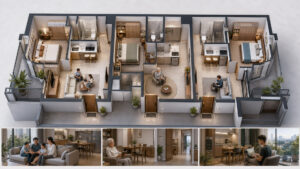
In a Dual-Key unit, the primary component and the secondary component each have their own entrance, bathroom, and kitchenette. The household can occupy the primary component and rent the secondary one at the same time. When the household’s composition changes, the secondary component absorbs the new occupant without renovation. A parent moves in. A sibling needs a base. A young adult child returns. The secondary unit handles each of these without requiring the primary household to relocate or restructure.
In a Trio-Key unit, three components operate independently. The household can occupy two and rent the third. Or occupy all three when the extended family needs space. Or occupy one and rent two when the household temporarily reduces in size. The configuration changes at the household’s discretion. No architect is required, no planning permission, no additional cost. The components are already built.
The own-stay vs investment property decision becomes a configuration question rather than a permanent commitment. The layout handles the transition without a sale or a renovation. Explore the Dual-Key and Trio-Key unit options at Ambang Residensi to see how the configurations work across different household compositions and at different life stages.
A layout built into the unit structure changes the investment equation. It removes the binary choice between own-stay and investment use. The household doesn’t have to pick a mode and commit to it for the life of the loan.
In a Dual-Key unit, the primary component and the secondary component each have their own entrance, bathroom, and kitchenette. The household can occupy the primary component and rent the secondary one at the same time. When the household’s composition changes, the secondary component absorbs the new occupant without renovation. A parent moves in. A sibling needs a base. A young adult child returns. The secondary unit handles each of these without requiring the primary household to relocate or restructure.
In a Trio-Key unit, three components operate independently. The household can occupy two and rent the third. Or occupy all three when the extended family needs space. Or occupy one and rent two when the household temporarily reduces in size. The configuration changes at the household’s discretion. No architect is required, no planning permission, no additional cost. The components are already built.
The own-stay vs investment property decision becomes a configuration question rather than a permanent commitment. The layout handles the transition without a sale or a renovation. Explore the Dual-Key and Trio-Key unit options at Ambang Residensi to see how the configurations work across different household compositions and at different life stages.
Why Freehold Tenure Matters for Long-Term Property Planning
Long-term property planning requires understanding what happens to a property’s value over time. That means not just its market price, but its financeability and resale liquidity. A leasehold property’s most useful years as a financeable, liquid asset are the first 40 years after completion. During that window, the remaining lease stays above 60 years, and banks are willing to lend against it at standard loan-to-value ratios. After that, the remaining lease shortens past the threshold where most banks apply restrictions or reduce the margin of finance. A buyer who holds a leasehold unit for 20 years and then tries to sell or refinance faces a reduced buyer pool. The pool narrows further each year as the remaining lease shortens. That narrowing happens regardless of what the property market is doing, regardless of the development’s quality, and regardless of the unit’s condition. A freehold property doesn’t experience that deterioration. The strata title at Ambang Residensi is freehold. A buyer who holds the unit through a job relocation, a multi-generational phase, a rental period, and a return to owner-occupation covers a 15- to 20-year cycle that spans most of a family’s active life stages. That buyer comes out the other end with a property whose tenure hasn’t diminished. The unit is as financeable and as saleable in the year 20 as it was in year one. The same freehold argument applies to the development’s 32 shop offices, which sit on the same freehold land and benefit from the same permanence of tenure. A freehold unit doesn’t clock down. For a Klang address built around life-stage flexibility, that absence of a depreciating timeline is one of the most durable structural advantages the tenure provides.Is Property Investment in Klang at Ambang Residensi Right for Your Life Plan?
A property investment that works when your life plan changes can shift from own-stay to partially rented to fully rented and back, without a sale, without renovation, and without a change in the fundamental asset structure. For buyers doing property planning over the long term in the Klang South corridor, Ambang Residensi provides that flexibility through Dual-Key and Trio-Key layouts that are structurally independent by component, freehold tenure that doesn’t deteriorate across a 20-year holding period, LRT3 rail access that supports rental demand from commuters, and a mixed-use address with 32 shop offices and a wholesale hub at 400 metres. The own-stay and the investment question don’t need to be answered permanently on the day of purchase. The design answers it differently at each stage of the household’s life, from single occupancy to family use to multi-generational arrangement to partial rental and back.Frequently Asked Questions