
What Dual Key and Trio Key Layouts Reveal About Klang Buyer Priorities?
Key Takeaway
- At Ambang Residensi, the dual key vs trio key condo option lets a single purchase support multiple living arrangements, which the standard layouts at the same size cannot do.
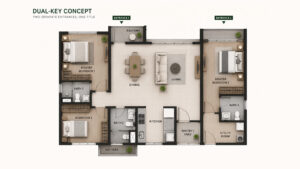
- The Dual-Key (Type D1, 990 sqft) divides into a main portion and a smaller sub-unit. Each has its own door from a shared foyer, its own bathroom, and its own sleeping space.
- The Trio-Key (Type E1, 1,238 sqft) divides into three portions from the same shared foyer. The third portion is more compact than the second, closer in size to a large studio room.
- Both layouts suit households with specific arrangements in mind: parents and adult children, owner plus one tenant, or three adults sharing costs. They’re less suited to households that don’t have a clear use for each portion from the start.
- The standard equivalents (Type D2 and Type E2) offer the same total square footage as open, undivided space, a better fit for households that don’t need the separation.
Introduction
The layout names are self-explanatory up to a point. One unit, two keys, two separate doors. Or three keys, three doors. What they don’t tell you is what each portion looks like after the split. Or which situations each layout actually serves.
This piece maps both layouts at the floor plan level using Ambang Residensi’s Type D1 and Type E1. It also covers the standard equivalents (Type D2 and E2), because the undivided layout is sometimes the more practical choice.
What Each Layout Produces at Floor Plan Level
At Ambang Residensi, both split configurations begin from a shared foyer just inside the main entrance. From that foyer, each portion has its own door and its own key. The portions do not share a kitchen or living space. Each has its own.
Dual-Key: Type D1 at 990 sqft
The 990 sqft divides into a larger main portion and a smaller sub-unit.
Main portion: Primary bedroom, full bathroom, living area, and full kitchen. Comfortably sized for one or two people, with proportions similar to a standard one-to-two-bedroom apartment.
Sub-unit: One bedroom, one bathroom, and a kitchenette rather than a full kitchen. The space works for one person who needs a private room with sleeping, washing, and basic cooking facilities. It’s compact, closer to a well-fitted hotel suite than a full apartment, and the proportions reflect that. Someone expecting a separate living room and a proper kitchen will find the sub-unit smaller than they imagined.
Shared foyer: Both parties use the same main entrance. They hear the main door open and close, and they pass through the same entry point. For a family or people who know each other, this is a non-issue. For strangers, it’s a layer of proximity worth factoring in.
Trio-Key: Type E1 at 1,238 sqft
The 1,238 sqft divides into three portions. That’s only 248 sqft more than the Dual-Key, spread across three spaces instead of two.
Primary portion: The largest of the three, with its own bedroom, bathroom, and kitchen. Has given up some square footage to accommodate the other two portions, so it’s not as spacious as a standard layout of the same unit size.
Second portion: One bedroom, one bathroom, one kitchenette. Similar in scale to a Dual-Key sub-unit.
Third portion: The smallest of the three. One bedroom, one bathroom, one kitchenette. The space works for a single person, but the proportions are noticeably tighter than the second portion, closer to a large studio room. Someone moving from the second portion into the third will feel the difference.
Shared foyer: Three parties cycling through the same main entrance daily. Still a single foyer, so the same proximity applies as with the Dual-Key, multiplied by one more person.
Which Household Type Does Each Layout Suit?

| Household situation | Dual-Key (D1) | Trio-Key (E1) |
|---|---|---|
| Parents + adult child’s family | Good fit | Sub-optimal: third portion too compact for a couple |
| Owner-occupant + one tenant | Good fit | Workable but adds tenant management complexity |
| Three working adults sharing costs | Tight for two parties | Good fit for three individuals |
| Investor renting both sub-units | Sub-unit is one, so limited | Good fit: two rentable portions |
| Household in transition (adding family later) | Can absorb sub-unit over time | More sub-unit capacity to repurpose |
| Family needing large shared space | Standard D2 suits better | Standard E2 suits better |
Dual-Key (Type D1) works best when:
- One party needs near-independence, not full separation. An elderly parent in the sub-unit gets a private room and bathroom without sharing the main family space. The shared foyer is close enough for easy check-ins, far enough for daily privacy.
- The owner wants rental income from one portion while living in the other. The sub-unit can be rented independently. The main unit stays owner-occupied. The shared foyer is not an issue because the tenant and owner don’t share any living space, only the entrance.
- One person needs a workspace that’s physically separate from the main unit. The sub-unit works as a dedicated home office or study room for a working adult who wants a door between work and home.
Dual-Key (Type D1) works less well when:
- The sub-unit occupant expects apartment-scale living. The sub-unit at 990 sqft total is functional but compact. It doesn’t have a separate living room or a full kitchen. A tenant or family member expecting a full one-bedroom apartment experience will find the space falls short.
- Both portions will be rented to unrelated strangers. The shared foyer is manageable for people who know each other. For strangers expecting complete independence, the shared entrance adds a layer of proximity that not everyone is comfortable with.
Trio-Key (Type E1) works best when:
- Three adults need separate private rooms under one ownership. Each portion has its own door, bathroom, and kitchenette. Cost-sharing is the main driver here. No single portion is large, but each is self-contained for a single adult whose priority is a private room in a well-located building.
- An investor wants two rentable portions alongside one owner-occupied space. The primary portion is for the owner, with two sub-units for tenants. Two income streams from one unit. Worth noting: managing two separate tenancies at once means coordinating lease start dates, maintenance calls, and possible vacancy periods independently.
- A couple is buying early and wants income now, flexibility later. Rent out the sub-units while living in the primary portion. When family grows, the sub-units can be absorbed back into a larger living arrangement.
Trio-Key (Type E1) works less well when:
- The third portion needs to house a couple. The third portion is the smallest of the three. It fits one person comfortably. Two people will find it tight for anything beyond occasional use.
- The three parties have significantly different daily routines. Late hours, frequent guests, or different standards for shared spaces become harder to manage when three households are cycling through the same entrance point. The compact shared foyer amplifies whatever friction exists between the parties.
What the Standard Layouts Offer Instead
If you don’t have a clear use for each portion from day one, the standard equivalents are worth comparing:
- Type D2 (990 sqft, standard layout): Same total size as the Dual-Key, but without the sub-unit division. More open living space per person, a full kitchen, and no shared foyer considerations.
- Type E2 (1,238 sqft, standard layout): Same total size as the Trio-Key, configured as a full family apartment. Better room proportions throughout, no split entry point.
The question is simply whether the household has a specific arrangement in mind for each portion. If yes, the split layout delivers something the standard layout cannot. If a portion will sit unused, the open layout is the more liveable choice.
Frequently Asked Questions

1. What is the difference between dual key vs trio key condo layouts at Ambang Residensi?
A dual-key condo splits one unit into two separate portions, each with its own door from a shared foyer. A trio-key adds a third portion. At Ambang Residensi, the Dual-Key is Type D1 at 990 sqft, and the Trio-Key is Type E1 at 1,238 sqft. Both sit on one ownership title and one set of documents. The difference is how many separate living spaces the unit produces, and how much space each ends up with.
2. Does the shared foyer affect privacy in a dual-key or trio-key unit?
The foyer is the main entrance point before the unit splits into separate portions. It’s not a shared living area. Each portion has its own door from there. Both parties use the same entrance, so they hear the main door and see each other coming and going. For family members or people who know each other, this is rarely an issue. For unrelated tenants who want full independence, it’s worth factoring in before deciding.
3. Can the sub-unit in a dual key condo in Malaysia be rented out?
Yes. In a dual-key condo in Malaysia, the sub-unit can be rented independently while the owner lives in the main portion. The rental income offsets the monthly repayment. Buyers should check the building management’s rules on tenancy types before committing to a rental arrangement.
4. Which layout is better for multigenerational living at Ambang Residensi?
For parents living with their adult child’s family, the Dual-Key at Type D1 is the more practical option. The sub-unit gives parents a private bedroom, bathroom, and kitchenette with their own door. The Trio-Key adds a third space. That third portion works better for one person than a couple.
5. What does the trio key layout look like at Ambang Residensi?
The trio key layout at Ambang Residensi is Type E1 at 1,238 sqft: three bedrooms, three bathrooms, three separate doors. The three portions vary: the primary is the largest, the second is mid-sized, and the third is compact, closer to a studio. All three share the main entrance foyer and are independent from that point inward.
Conclusion
Both the Dual-Key (Type D1) and Trio-Key (Type E1) are available alongside their standard equivalents at the same square footage. The right dual-key vs. trio-key condo choice depends on what the household plans to do with each portion. The residential page has full floor plan details and unit comparisons. Our team can walk you through D1 vs D2, or E1 vs E2, side by side.
